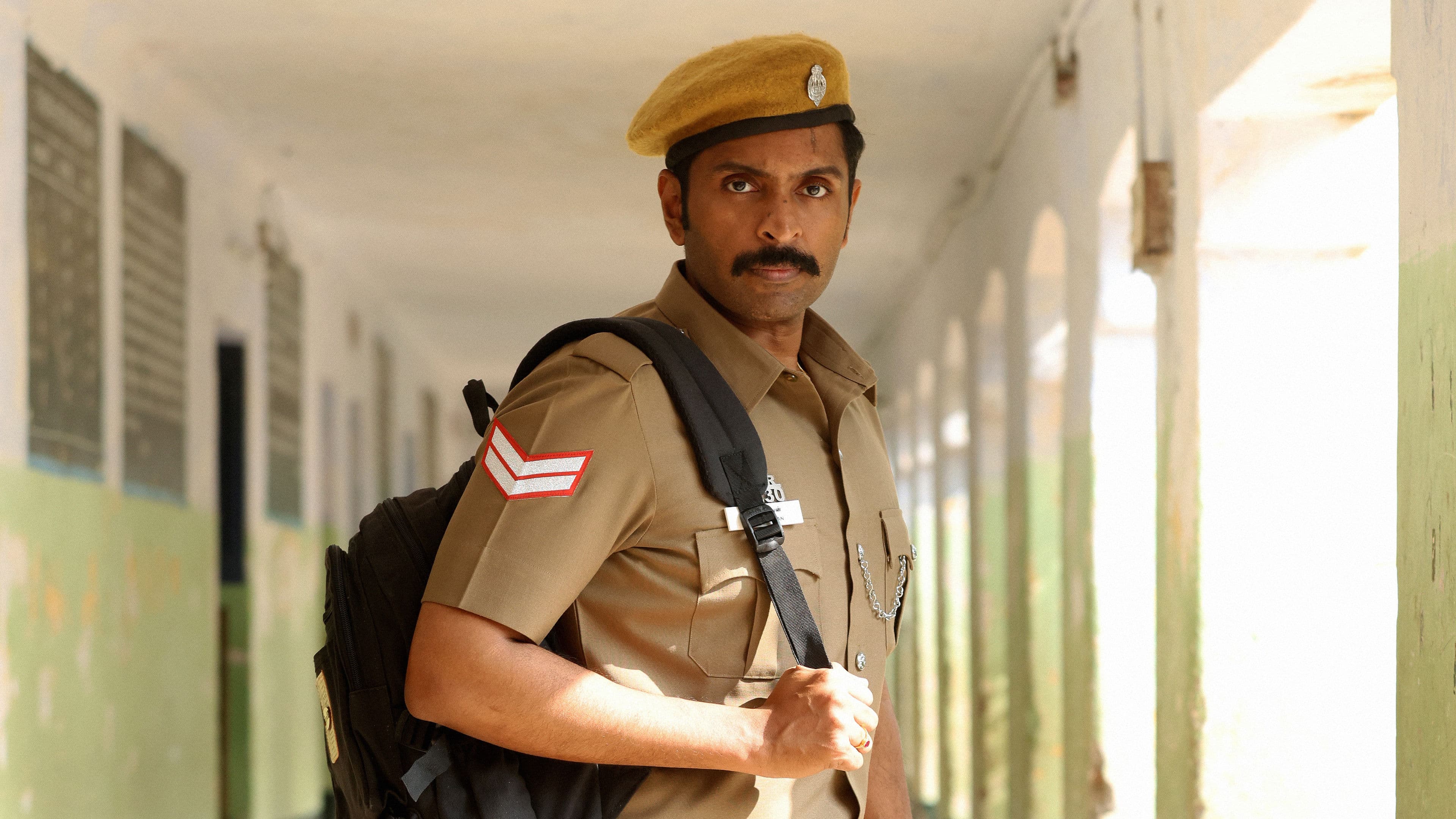
The first time Kathiravan sees Abdul Rauf, the young man is not a person. He is a file number, a prisoner transfer request, a pair of eyes hollowed out by months of waiting. Vikram Prabhu plays the police officer with a practiced stoicism, the kind of quiet that comes from years of moving bodies between cells and courtrooms without asking why. But "Sirai," director Suresh Rajakumari’s 124-minute drama, asks the question anyway: what happens when the man in handcuffs was never the real criminal?
The film opens on Christmas Day 2025 with a procedural rhythm - shackles, a van, a dusty road from prison to the Madurai bench. Kathiravan has done this a thousand times. Yet something about Abdul (Lk Akshay Kumar) unsettles him. The convict is not belligerent, not weeping. He is eerily resigned, as if the violence that put him behind bars was the only logical answer to a question no one else dared to ask. Over the course of a single, extended drive, Abdul begins to talk. What follows is not a confession but a reckoning: a story that spirals backward through a forbidden romance, a mother’s fierce love, and the slow corrosion of a man pushed past his breaking point.
Rajakumari, working from a script that favors intimate conversation over action set-pieces, builds the narrative in layered flashbacks. We meet Kalaiarasi (Anishma Anilkumar), a young woman whose smile suggests she knows exactly how dangerous hope can be. Her courtship with Abdul is tender, shot in warm golden tones that deliberately clash with the sterile grey of the present-day van. The romance genre tag is earned honestly - their scenes together carry the ache of young people who believe love can outrun circumstance. But circumstance, in this world, wears the uniform of the state. Abdul’s crime, we learn, was not born of malice but of a desperate attempt to protect Kalaiarasi from a threat the law refused to acknowledge.
The supporting cast elevates every flashback. Ananda Thambirajah as Mariyam, Abdul’s mother, delivers a gutting monologue midway through the film about the cost of raising a good son in a bad system; her words land with the force of a physical blow. Remya Suresh, as Abdul’s mother in the present-day timeline, offers a quieter counterpart - her silence in the van’s back seat says more than any dialogue could. Ismath Banu’s Selvi and ‘Maina’ M. Poovitha’s Karpagam add texture to the community surrounding the central couple, while P.L. Thenappan’s Judge Rathnavel Pandian represents the kind of institutional blindness that turns tragedy into jurisprudence.
Vikram Prabhu deserves particular credit for refusing to make Kathiravan a simple audience surrogate. He listens with the guarded weariness of a man who has heard every excuse, every sad story, every lie. But Kumar’s Abdul is not lying. The young actor - discovered through regional theatre, reportedly - plays his scenes with a rawness that feels unpolished in the best way. When he describes the moment his fists met another man’s face, he does not flinch. His eyes are wet, but his voice is steady. Kathiravan’s gradual shift from indifference to unease to something like empathy is mapped entirely on Prabhu’s face; by the final act, the officer’s uniform seems to fit him differently.
Rajakumari directs with a patience that modern Kollywood thrillers often lack. There are long stretches where nothing explosive happens, just two men talking over lukewarm tea or the hum of the van’s engine. But the tension is always there, coiled under the dialogue. The cinematography contrasts the cramped, moving space of the prison vehicle with the vast, open fields of flashback, reinforcing the idea that freedom is not merely physical. The editing, particularly in a crucial sequence where Abdul recounts the night of the crime, cuts between three timelines with a precision that clarifies rather than confuses.
Released theatrically on December 25, 2025, "Sirai" was never positioned as a blockbuster. Its current TMDb score of 6.4 out of 10 reflects a film that critics have praised for its performances while some viewers found its pacing deliberate to a fault. But this is a movie that rewards patience. It asks not whether violence is ever justified, but rather who gets to define the term “violence” in the first place. When Kathiravan finally reaches the courthouse, the film has already delivered its quiet verdict. The chains are real. The crime is real. But the line between guard and prisoner, it turns out, is just a line drawn in dust.
In the end, "Sirai" is less about a single act of violence and more about the long, silent road that carries all of us toward our judgments. It stays with you, not for its twists, but for its unbearable clarity: that sometimes the man who breaks the law is the only one who refused to break a promise.