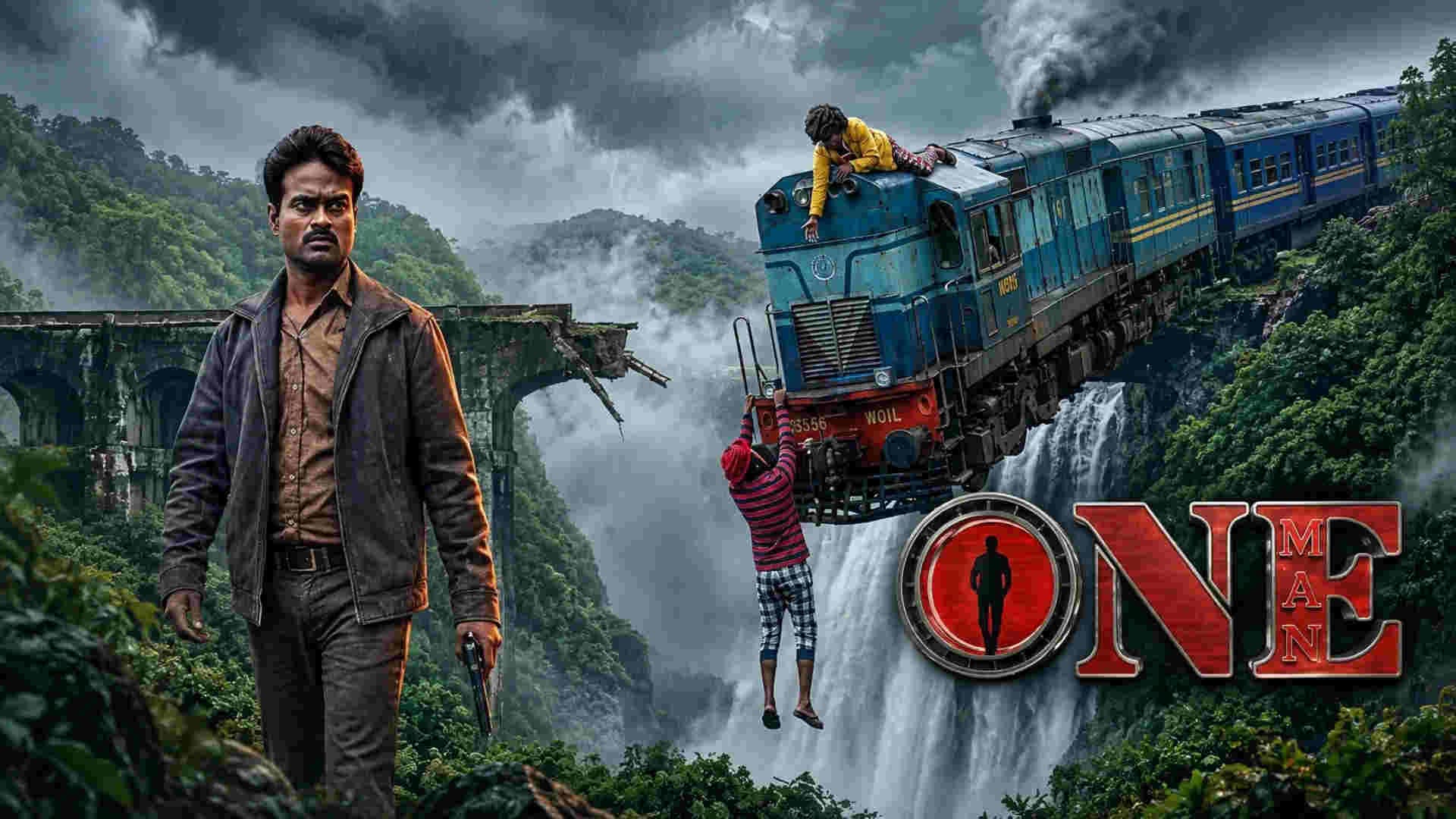
Five friends wander into a forest and walk out with the power to stop time. That is the deceptively simple premise of One Man, a Tamil action-science fiction film that arrived in theatres on August 21, 2026, and has since quietly become one of the year's strangest talking points in Kollywood.
The film is directed by Sankagiri Rajkumar, who also headlines the cast in no fewer than six roles: Raja, Ruby, Jack, Puma, Mother, and Father. It is an unusual arrangement by any measure, one that places the entire emotional architecture of the story on a single performer's shoulders. Whether that gamble pays off is a question audiences will answer for themselves. What is certain is that One Man is not assembled from the usual spare parts.
The narrative follows a group of five friends who, while stranded in a forest, happen upon a peculiar factory. What they find inside defies ordinary explanation. The factory offers a way to freeze the entire world, bringing everything to a standstill for ten days. Ten days in which nothing moves, nothing changes, and presumably nothing can stop them. It is a premise that borrows liberally from the science fiction canon while folding in the survival instincts of a wilderness thriller, and the film's 100-minute runtime suggests it wastes little time getting to the consequences.
Those consequences are where One Man stakes its claim. A frozen world is a gift and a trap in equal measure, and the screenplay, mounted as an action vehicle with science fiction underpinnings, appears to treat the discovery less as a miracle and more as a countdown. Five friends, one impossible machine, and ten days of absolute stillness. The math may be simple, but the moral arithmetic rarely is.
Rajkumar's decision to play six parts is the film's most conspicuous creative choice. It is the kind of role that asks an actor to generate an entire world from a single performance, and it echoes a tradition of transformation-driven cinema that Tamil audiences have long embraced, where one performer anchors a story that might otherwise require an ensemble. Here the doubling and tripling are structural rather than gimmicky, at least by design. The friends, the parents, the central figure at the story's heart: all of them are filtered through the same face.
Behind the camera, Rajkumar directs his own material, a dual burden that has produced some of the most distinctive work in Indian genre cinema when it goes right. The film's visual scheme, built around a world that simply stops, presents obvious challenges. Stillness on screen is difficult to sustain without losing momentum, and One Man appears to answer that problem with action, keeping its characters moving through a landscape where nothing else can.
The film's reception, at least as measured by TMDb, remains unsettled, showing a rating of 0 out of 10, which typically indicates an insufficient volume of user votes rather than a consensus judgment. It is a data point worth acknowledging without reading too much into it; in the weeks since release, One Man has sat in a curious space between curiosity and obscurity, the fate of many independent genre efforts that lack the machinery of a large studio push.
What One Man has working in its favour is genuine novelty. A Tamil action science fiction film about a factory that freezes the world for ten days, made by a filmmaker who cast himself in six roles, is not a project assembled by committee. It comes from a place of conviction, or at least of stubbornness, and in a market increasingly dominated by sequels and franchises, there is something bracing about a film that simply declares its own strange rules and dares the audience to follow.
Tamil cinema has a long history of embracing the fantastical, from masked avengers to mythological epics, and One Man slots into that lineage while aiming for something more contemporary. Its 100-minute running time is lean for a film of this scale, suggesting a story built for propulsion rather than exposition, and the action-science fiction hybrid gives its director room to stage set pieces within a premise that, by definition, should make set pieces impossible.
Whether the film finds a wider audience beyond its initial release window remains to be seen. But One Man has already done something worth noting: it has given Tamil audiences a premise nobody else is offering, executed by a filmmaker willing to stand at the centre of his own creation, six times over. In a landscape of familiar shapes, that alone is a small act of defiance.