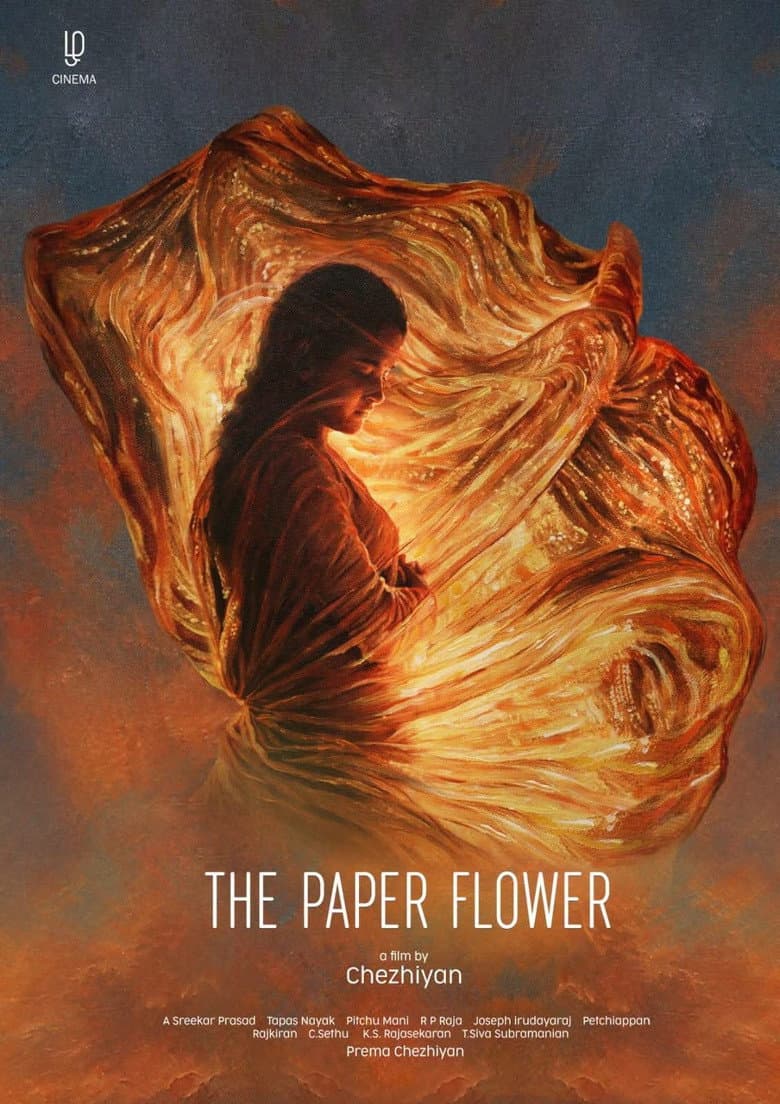
There is a particular kind of quiet that settles over a book fair in the late afternoon - the hush of pages turning, the low murmur of strangers negotiating prices, the smell of old paper and new ink. It is exactly the sort of setting where a filmmaker like Chezhiyan would choose to stage a reunion. The director, whose debut feature To Let earned him a National Film Award for Best Feature Film in Tamil, has spent his career finding emotional weight in the mundane, and his next release looks determined to continue that tradition. The Paper Flower arrives in theatres on October 29, 2026, and it promises to be one of the more intimate Tamil dramas of the year.
Release Date & Where to Watch
The film opens in theatres across Tamil Nadu on October 29, 2026, a Thursday release that positions it squarely in the festival season window. With a runtime of just 75 minutes, it is a notably compact feature, closer in length to a long short film than the three-hour epics Kollywood audiences are accustomed to. The film's original language is Tamil, and it will release under the Kollywood banner. It is currently carrying a TMDb rating of 0/10, which simply reflects that no audience votes have been registered yet. Those numbers will begin to mean something only once the first shows begin. Given the specialised nature of the film and Chezhiyan's track record with festival and limited-release circuits, viewers outside major urban centres should watch for streaming announcements following the theatrical window, though no platform has been confirmed at this stage.
Cast & Crew
Chezhiyan directs, continuing a filmography defined by patience and observation rather than spectacle. His work has never chased scale; it chases the small truth inside a larger situation. The Paper Flower sits comfortably within that sensibility.
Leading the cast is Parandhaga Cholan as the male artist who works at the book fair. Opposite him is Janani Shenbaga, playing the woman from his past. Both performers carry the kind of unshowy presence this material demands - a film built on glances across bookstalls cannot survive a false note. The rest of the crew remains under wraps, and the makers have kept promotional material deliberately minimal, which itself feels like a statement of intent. This is a film that wants to be discovered rather than sold.
Story & What to Expect
The premise is simple, almost deceptive in its simplicity. A male artist is working at a book fair when he encounters a woman he once had feelings for. Nothing dramatic follows - no confrontation, no grand declaration, no swelling score beneath a rain-soaked embrace. Instead, what unfolds is a platonic love, mediated and shaped by the books around them. Their connection is refracted through titles, margins, dog-eared pages, conversations that circle around something neither is willing to name directly.
That is the gamble of the film. It asks whether affection that never converts into romance can still be the most important relationship in a person's life. Chezhiyan has never been interested in the loudest emotion in the room; he is interested in the one nobody says out loud. Expect long takes, natural light, ambient sound, and long stretches where dialogue gives way to silence. The 75-minute runtime is not an accident - this is a film designed to be experienced in a single, uninterrupted breath. Audiences raised on interval-heavy storytelling may find the format jarring, but it also means the film carries no padding whatsoever. Every scene earns its place.
The book fair setting does double duty. It is a physical location and a metaphor, a marketplace of stories where two people are quietly writing one of their own. If Chezhiyan's earlier work is any indication, the emotional payoff will not arrive through a twist or a revelation but through accumulation, the way real feelings build.
Why It's Worth Watching
Because Tamil cinema does not make enough films like this. Between the mass action entertainers and the large-scale period dramas, there is a genuine shortage of small, tender, character-driven work, and it takes a director of established credibility to get one funded and released theatrically at all. Chezhiyan has that credibility, and he is spending it on something deliberately modest.
The Paper Flower also offers a rare on-screen study of platonic love between a man and a woman, a subject that mainstream Tamil cinema has historically treated as either a punchline or a pit stop on the road to romance. If the film handles it honestly, it will be quietly radical.
A 75-minute runtime means low risk and potentially high reward. If it works, it will linger. If it does not, you will have lost less than the length of a cricket innings. Either way, the theatre will smell of paper and ink for a weekend. For audiences tired of being shouted at by their movies, that may be reason enough. Watch for it on October 29.