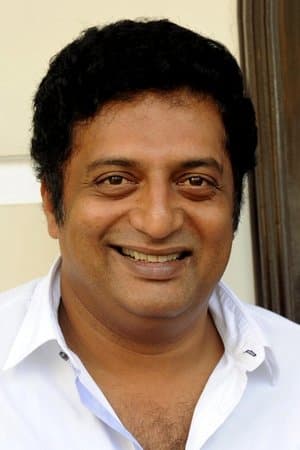
Place Prakash Raj for a reader who has never seen a Tamil film and the answer is usually a shrug and a face they half know from somewhere. That is the odd thing about a career this long. He is one of the most recognisable presences in South Indian cinema, yet he is rarely the reason a film gets made. He is the reason it holds together.
The part that is easy to miss
Start with vocabulary, because this audience meets the industry from outside it. In Tamil cinema the antagonist is the character who stands against the lead. The word covers far more ground than "villain" does: a rival, a hostile relative, an officer of the law, a man whose interests simply do not bend. Prakash Raj built a reputation in exactly that space, then spent the rest of his career widening it.
He began elsewhere. Born Prakash Rai on 26 March 1965, he made his film debut in the Kannada film Mithileya Seetheyaru in 1988 and only later moved into Tamil and Telugu work. That matters to how his career reads. The menace he brought to Tamil screens arrived already formed, with a different industry's rhythms behind it.
The clearest marker of how his work has been received is the National Film Award for Best Supporting Actor, which he won for playing the politician Tamizhselvan in Mani Ratnam's Tamil political drama Iruvar (1997). A supporting role is any substantial part below the lead, and the award is India's highest national honour for film performance, as the National Film Awards framework sets out. It went to him early in his Tamil run, for a political portrait rather than a straightforward heavy. Read that as a signal: what gets rewarded in this career is not volume of menace but the texture underneath it.
What connects the work is control. He plays people who have already decided how the room will go, so the performance lives mostly in what he withholds.
The films, and what each one added
The breadth shows in the filmography itself. Early Tamil work placed him in character and antagonist parts: Antahpuram (1998), Padayappa (1999) as a police officer, Badri (2000) and Ghilli (2004), a stretch that made his face a fixture of the period. Anniyan (2005) gave him DCP Prabhakar, and Arinthum Ariyamalum the same year placed him as Adhi Narayanan. Pokiri (2006) belongs to this run as well.
Then the frame widens. Bommarillu (2006) and Abhiyum Naanum (2008) put him in the patriarch's chair in family dramas, a register he now occupies as easily as the police station. Thiruchitrambalam (2022) made him Inspector Neelakandan, small and human rather than fearsome. Annaatthe (2021) gave him Nattadurai. Varisu (2023) cast him as Jayaprakash, known as JP.
The prestige work sits alongside it. Jai Bhim (2021) is the story of a pregnant woman from a tribal community searching for her husband after he disappears in police custody, and of a High Court advocate who takes up their cause; Prakash Raj plays Perumalsamy. Ponniyin Selvan: Part I (2022) and Part II (2023) cast him as Sundara Chozhar, a Chola emperor in a historical epic.
The most recent confirmed titles sit at opposite ends. Retro (2025) follows Dharmendran, a man with a violent past who tries for a fresh start and finds old conflicts returning. Jana Nayagan (2026) sets two ideologies against each other, drawing a former police officer into a fight larger than personal revenge, with Prakash Raj as Roja Rangasamy. One character carries a past he cannot shed, the other a choice he once made. Both are the kind of figure he has spent a career making legible.
The roles he keeps returning to, and why the name travels
Three types recur. The officer of the law: Prabhakar, Neelakandan, the policeman of Padayappa. The patriarch presiding over a family drama: Bommarillu, Abhiyum Naanum, JP in Varisu. And the man who commands a room by ideology or authority, from Iruvar to Jana Nayagan.
None of this is typecasting so much as a reliable register, the way a seasoned character performer becomes shorthand: the audience sees him and knows the stakes have arrived. The consistency is the point, not a limitation.
He also works across Tamil, Telugu, Kannada, Hindi and Malayalam, and has directed and produced as well. The Film Federation of India and similar bodies track that multilingual traffic, and the variety of titles listed here reflects it. For a reader outside the region, that breadth is the practical reason to know the name: subtitles flatten a great deal, but a performance built on stillness survives translation better than almost anything else on screen. Learn his face and you have a way of reading a Tamil film's power structure within a minute of it starting.
He is not the draw. He is the floor the whole thing stands on. That is the throughline of Prakash Raj: A Career In Tamil Cinema, and the reason the face keeps coming back.