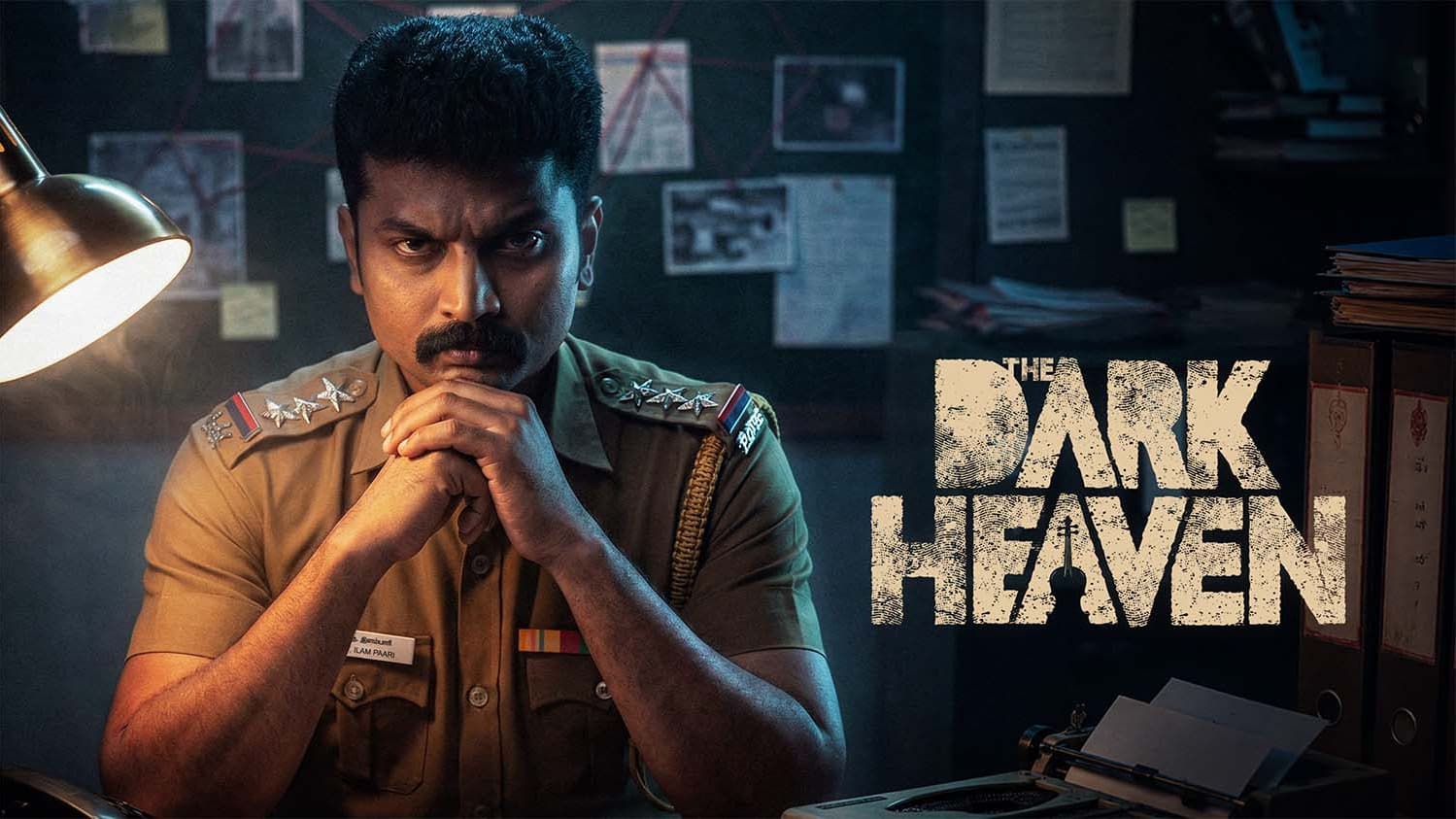
In the hill village of Mekkarai, the month of June is not a season of harvest or festival. It is a season of reckoning. Custom dictates that the men die every seven years, and the villagers have long accepted this grim rhythm as the price of their existence. This is the unsettling premise of The Dark Heaven, a new Tamil crime thriller that arrives in theatres today, September 18, 2026, carrying with it the kind of heavy, atmospheric dread that Tamil cinema has always excelled at crafting.
Directed by Balaaji, the film introduces us to a newly appointed police inspector who steps into Mekkarai expecting a routine posting. What he finds instead is a community bound by fear, superstition, and secrets buried as deep as the roots of the hills themselves. A series of mysterious murders pulls him further into the village's dark heart, and the deeper he digs, the more he realises that the line between belief and crime in Mekkarai is dangerously thin. The official synopsis describes him as "trapped in a web of crime, fear, and hidden truths," and that phrase captures the film's essential tension: a man of law and order confronting a place where order itself has been redefined by custom.
The casting carries significant weight for Tamil audiences. Sidhu Sid takes on the role of the inspector, bringing the kind of quiet intensity that such a conflicted protagonist demands. He is joined by Tharshika, whose recent work has shown a willingness to take on complex, emotionally layered characters. Riythvika, a performer known for her raw screen presence, adds further depth to the ensemble. Vela Ramamoorthy, a familiar face in Tamil cinema's rural dramas, and veteran Nizhalgal Ravi round out a cast that suggests the film is as much about the textures of village life as it is about the murders at its centre.
What sets The Dark Heaven apart from the standard investigative thriller is its refusal to treat the village's beliefs as mere backdrop. The seven-year cycle of death is not a supernatural gimmick; it is the organising principle of Mekkarai's society. The film seems to ask uncomfortable questions. What happens when a community's traditions become indistinguishable from its crimes? When does faith become complicity? The inspector's investigation is, at its core, a collision between two ways of understanding the world - one rooted in evidence and procedure, the other in prophecy and appeasement.
Director Balaaji has chosen a tone that appears pitched somewhere between dread and revelation. The hill village setting, with its isolation and its closed social order, provides a pressure cooker environment. In such places, secrets do not stay buried for long, but neither do they surface easily. The film's title itself carries a contradiction - the dark heaven - suggesting that salvation and damnation in Mekkarai arrive through the same door.
Genres like crime and thriller are crowded territory in Tamil cinema, but the specificity of this premise gives The Dark Heaven a distinct identity. It is not a city-based procedural, nor is it a pure folk horror. It occupies an uneasy middle ground where the psychological and the mythological overlap. That space is fertile for storytelling, and if the execution matches the ambition of the premise, audiences could be in for something genuinely unsettling.
At the time of writing, The Dark Heaven holds a 0/10 rating on TMDb, which is not a reflection of quality but simply a consequence of the film releasing today. Ratings will populate as audiences watch and respond. The runtime remains unconfirmed, though the film's dense narrative suggests a substantial viewing experience.
What is already clear is that The Dark Heaven arrives with a clear sense of what it wants to be: a slow-burn investigation into the darkness that communities can normalise, and the outsiders who disrupt that normalisation at their own peril. The inspector is not just investigating murders; he is investigating the very foundation upon which a village has built its survival.
For Tamil cinema, this kind of genre filmmaking continues to expand what is possible on screen. The combination of rural mythology, crime procedural structure, and psychological tension is a potent one. Whether The Dark Heaven lands its final act will determine if it becomes a talking point or a footnote. But on the strength of its premise, its cast, and its willingness to confront uncomfortable questions, it has already made a case for attention.
In Mekkarai, the men die every seven years. In The Dark Heaven, we are asked to sit with that fact and ask why. The answer, the film suggests, is never simple. And sometimes, the darkest heavens are the ones we build ourselves.