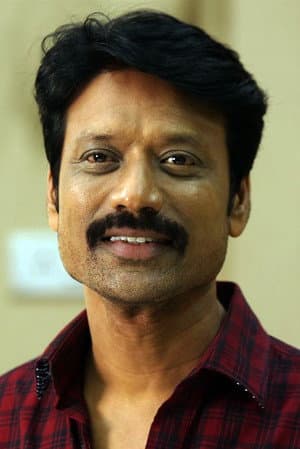
S. J. Suryah turns up in the credits of a surprising number of Tamil films. Sometimes he is in front of the camera, sometimes behind it. For readers who follow the industry from outside its home region, he can be a puzzling figure at first. He rarely takes the top billing, yet his presence often signals that a film has something going on beneath its surface. This piece traces the shape of that career: how he started, the films that define him, and why the name is worth learning.
A Filmmaker Who Became A Familiar Face
S. J. Suryah was born S. Justin Selvaraj in Vasudevanallur, Tamil Nadu. He came to the industry wanting to perform, but the path there was indirect. Before he ever stood in front of a camera, he assisted the directors Vasanth and Sabapathy, learning how a production actually functions. That apprenticeship is the foundation of everything that followed. He made his directorial debut with Vaalee in 1999, and its success pushed him into the limelight. Kushi (2000), New (2004) and Isai (2015) followed, establishing him as a filmmaker with a distinct voice.
This matters for anyone meeting him now as a performer. A director understands how a scene is built, where a shot lands, how a story is paced. That literacy shows in how economically he occupies a frame. He has also worked as a screenwriter, music composer and producer across the Tamil, Telugu and Hindi industries. His career has never sat in one lane. The early directorial run is the foundation, and everything since is a second act built on it.
The Roles That Built A Second Career
The filmography reads like a survey of modern Tamil cinema's biggest ensembles. In Mersal (2017) he plays Daniel Arockiaraj, part of a story about murders and kidnappings within the medical profession and a police investigation that turns on a doctor. The same year, Spyder cast him as Sudalai. Again and again he returned to the idea of the antagonist who is more than a foil. Maanaadu (2021) gave him Dhanushkodi, a role that asked for menace with a comic edge. Don (2022) followed with Boominathan. Varisu (2023) placed him in Adithya Mittal for a special appearance, a phrase worth unpacking for readers outside the region: it signals a brief but deliberate turn rather than a lead part, often used to give a story a jolt.
Jigarthanda DoubleX (2023) handed him the dual identity of Kirubai and Ray Das, and Raayan (2024) cast him as Sethuraman, known as Sethu. Indian 2: Zero Tolerance (2024) brought him in as Sarguna Pandian, a character carrying the grand title Sakalakala Vallavan. Two patterns emerge. He is trusted with characters who arrive with their own mythology attached, and he works across scales, from tight ensemble pieces to large productions, without visible adjustment. Thirumagan (2007) and the role of Thangapandi sit further back in the record, a reminder that the screen work stretches across a long stretch of the industry's recent history rather than a short burst.
Reading The Recent Slate
Three titles from 2026 point to where his work has settled. In Sardar 2 he plays Yoganandan, known as Yogi and also called Black Dagger, in a story about a threat to national security and the origin of a legendary spy. In Jailer 2 he is Bodhi Kalpak, part of a plot that pulls a retired jailer into an undercover operation against a syndicate threatening his family. Love Insurance Kompany places him as Suriyan in a near-future premise set in 2040, where an app promising romance for everyone is overturned by the voice behind its artificial intelligence. Taken together, these parts lean toward figures who operate in the shadows, hold secrets, or stand between the hero and the truth. That is familiar territory, and he has made a career of occupying it with variety rather than repetition.
Where He Sits, And Why The Name Matters
Tamil cinema has long rewarded performers who can move between the commercial mainstream and character work, and S. J. Suryah belongs to that tradition. He is not the lead in most of the titles above, yet several of them would lose their tension without him. The antagonist in a large Tamil film is often the engine of the second half, and he has become one of the people filmmakers call when that engine needs to run.
For a reader outside the region, the name is worth knowing for a simple reason: following Tamil cinema often means tracking a handful of faces across a decade of releases. He is one of those faces. His arc, from directing Vaalee and Kushi to standing opposite leads in Mersal, Maanaadu and Raayan, also says something about the industry itself, where skills move between departments and a career can be rebuilt more than once. The clearest way in is to pick two titles far apart and watch the same instincts at work.
For further context on Tamil cinema and its major figures, see the British Film Institute's resources on Indian cinema and IMDb's Tamil cinema listings.