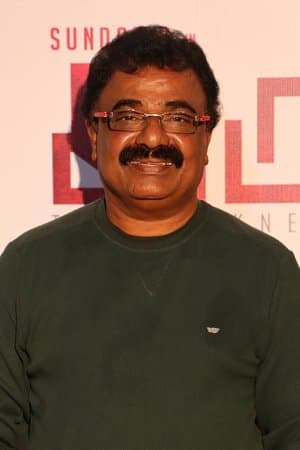
RJ Balaji: A Career In Tamil Cinema traces how one distinctive voice moved from a radio studio into the writing and directing of feature films. He came to the screen from broadcasting, and that origin explains almost everything about the work he is recognised for. In his early appearances he played the talkative friend, the colleague, the comic sidekick: parts that let a quick, conversational voice carry a scene. Over time he began writing the films he appears in, and then directing them. The through line is the voice itself, a sharp, fluent talker who takes on ordinary people against larger systems. Anyone who follows Tamil film from outside the region can read this career as one long widening of that role, from cameo to lead.
 Photo: TMDb
The Filmography, Role by Role
The confirmed record begins in the supporting register. In Naaigal Jaakirathai (2014) he appears as Anbu Das, and in Vallinam (2014) as a show host in a brief cameo, a part that sits close to his broadcasting background. The next few years build a gallery of comic companions: Balaji in Pugazh and in Kadavul Irukaan Kumaru, and Natty Nataraj in Kavalai Vendam, all in 2016. These are the years that taught a radio performer screen timing.
Later roles gave him more to carry. In Velaikkaran (2017) he plays Sriram, in Devi 2 (2019) Ganesh and Madasamy, in Mr. Local (2019) a role inside a mainstream comedy, and in Boomerang (2019) Shanmugam. Alongside these he was writing for the screen, and the filmography lists him with story, screenplay, director and writer credits, not merely performances.
Two titles mark the shift most clearly. Mookuthi Amman (2020), which he directed and for which he wrote the story and screenplay, and in which he appears as Engels Ramasamy, casts a television reporter chasing a self-styled godman until the goddess of the title intervenes. Karuppu (2026), again directed and written by him, with the lead role credited as Baby Kannan "BK," also listed as Usilampatti Karuppaiah Gandhi "UKG," imagines the guardian deity Vettai Karuppu taking the form of a lawyer to fight a corrupt legal system. The arc from talkative sidekick to the maker of a film about a god who becomes a lawyer is the clearest summary of the career.
What Keeps Bringing Him Back
Two subjects recur across the work. The first is the ordinary person against a rigged institution. In Mookuthi Amman the target is a self-styled godman. In Karuppu it is a corrupt legal system. In Pugazh (2016), where he plays a young man defending a neighbourhood playground from a politician who wants the land, the fight is local and tangible. The second subject is the everyday relationship. Kavalai Vendam (2016) sends a chef after a marriage he lost. Taken together, the films show a performer drawn to decency under pressure, and to faith treated as a force for the weak rather than a tool of the powerful.
Three terms are worth explaining for readers outside the region. A radio jockey, or RJ, hosts a phone-in radio show, and Balaji's screen persona borrows its rhythm. A sidekick, or comic track, is a supporting role that supplies humour around a lead. A story credit means the person devised the film's plot, while a screenplay credit means the arrangement of its scenes and dialogue. Background on his broadcasting years is available through public profiles of his radio work.
Where He Sits, and Why the Name Matters
RJ Balaji sits in the populist wing of Tamil cinema, a broad term for films built for mass audiences that still argue about corruption, faith and community. His career is a useful map of how Tamil cinema lets a distinctive voice migrate from radio into writing and direction. For a reader outside the region, his name points to a specific kind of filmmaking: comedy with a point of view, and an interest in who the law and the gods actually serve.
The widening happened in stages: cameo, comic companion, supporting lead, then the person who devises the plot and stands behind the camera. Each stage kept the same instrument, a fast, fluent talker, and pointed it at a bigger target, from a playground to a godman to a court. That consistency is why the name matters. It signals a film that will make you laugh and then ask who the system was built to protect. Readers who want the wider context of the industry can follow coverage of Tamil cinema alongside the filmography above, and readers new to the industry vocabulary can return to this piece as a short glossary. The career, read through the filmography, is the argument: a voice that started on the radio and ended up writing the story.