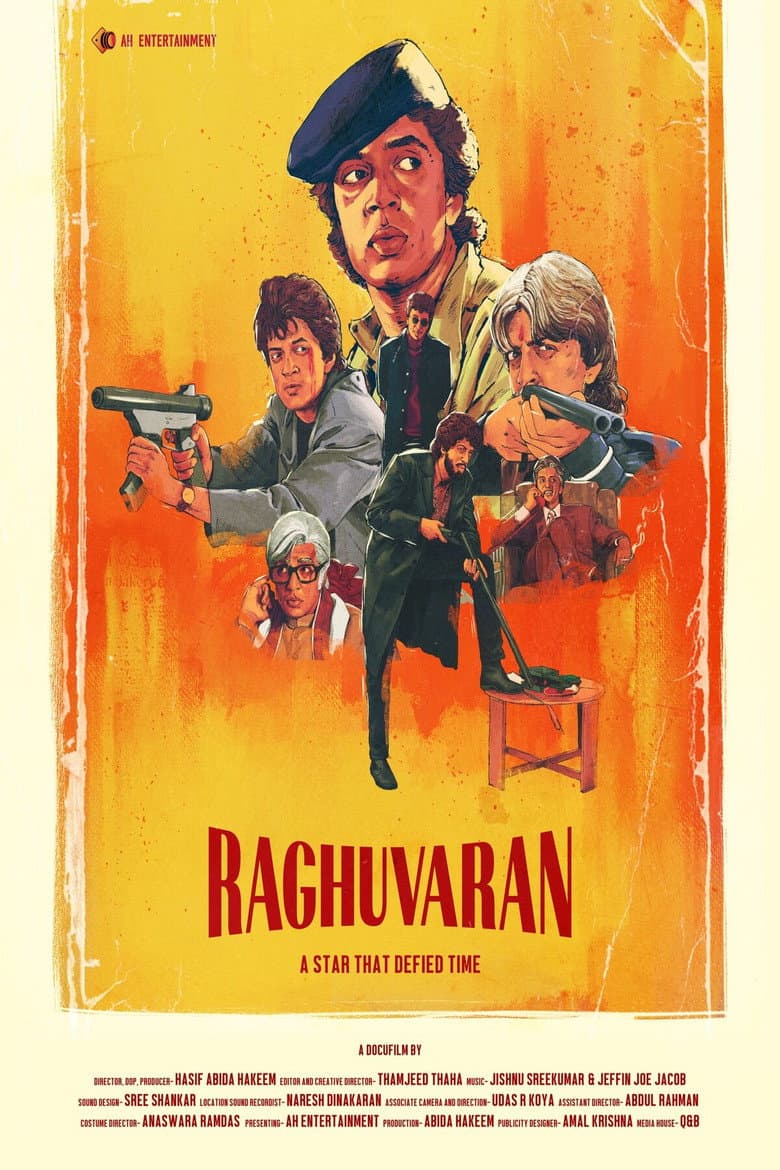
Some careers are best understood through a single unforgettable part. Others read better as a spread, a long line of appearances that together show what an industry asks of a working performer. Raghuvaran: A Career In Tamil Cinema belongs firmly in the second category. His name sits across more than 150 films in Malayalam, Tamil, Telugu, Kannada and Hindi, according to TMDb, and the reputation rests largely on villain and character roles in Tamil films. That phrase, character roles, needs explaining for readers who follow the industry from outside the region. It means the parts that carry the plot without being the top-billed hero: the official, the father, the man with something to lose. A film needs those figures to function, and the performers who fill them well are the reason a large story holds together. This piece traces the body of work through a set of confirmed Tamil credits, from the late 1980s into the 2000s, and asks what that spread tells us about how Tamil cinema uses its supporting strength.
A Body of Work Built on Range
The careers most worth tracing rarely rest on a single signature part, and this one is a case in point. His filmography moves between the enemy who drives a story and the figure who stands beside the lead, often within a few years of each other. The range is the point. He was not a performer who found one note and stayed there. The titles alone show the spread: a police chief here, a family elder there, a scheming opponent elsewhere.
This is why the phrase "Raghuvaran: A Career In Tamil Cinema" describes more than a list of films. It describes a method. Commercial Tamil cinema of the period was built on a commanding lead at the centre and a strong opposing presence to push against. A performer who could supply that opposition credibly, then turn around and anchor a household scene without asking for attention, was doing two different jobs. The middle ground of an industry is where a large share of its craft lives, and his filmography works as a map of it.
That range also explains the reach. TMDb records him across five languages, a useful way into how Tamil cinema has always shared talent with its neighbours. A leading part taken on in a Malayalam film and a character part in a Tamil one belong to one body of work rather than separate ones. Hindustan Times noted the style and voice modulation that set him apart, along with critical praise for his role as Father Alphonso in the Malayalam film Daivathinte Vikruthikal, directed by Lenin Rajendran and based on M. Mukundan's novel. Here is a performer whose standing crossed borders.
The Films and What Each One Carries
Playing the Opposition
Arunachalam (1997), with him as Vishwanath, and Muthu (1995), with him as Rajasekharan, are the commercial Tamil cinema of their era in full. A commanding lead at the centre, a strong opposing presence to push against, and a story that needs both to move.
Vallarasu (2000) puts him in uniform as DGP Jagannathan, shifting his weight to the institutional side of the story. Kuttravaali (1989) as Raaja places him among the earlier confirmed credits, and Star (2001) as Dhanushkodi follows. In Anjaneya (2003) he plays Venketeaswaran, opposite a story about a police officer who disguises himself as a thief to get at the people he is chasing. The villains, as the plot summary puts it, discover who he really is and turn on him together.
Beside the Lead
Sivaji: The Boss (2007) casts him as Dr. Chezhian, in a story about a wealthy engineer who returns to India intending to invest in the country's welfare and finds determined opposition from corrupt officials and politicians. The part sits close to the centre of that conflict. Kandukondain Kandukondain (2000) gives him the role of Boss, in a different register from the confrontations above. In Yaaradi Nee Mohini (2008) he is credited as Vasu's Father. Vasu falls for Keerthi, is refused because her marriage is already arranged, and then learns the man she is to marry is his close friend Cheenu. Parts of this kind are easy to overlook. They are also what keeps a large film's family world believable, and his shift into them in the later titles on the list shows a performer adapting rather than repeating.
Earlier Entries
Dhool Parakuthu (1993) is listed as directed by Raja, with Raghuvaran, Ramya Krishnan, Ravi Raghavendra and Malaysia Vasudevan in the lead roles. Nadodi Mannan (1995) and Nerrukku Ner (1997), where he appears as Raghu, round out this set of the confirmed credits. Read together, these titles show how quickly he moved between the centre of a film and its supporting ring.